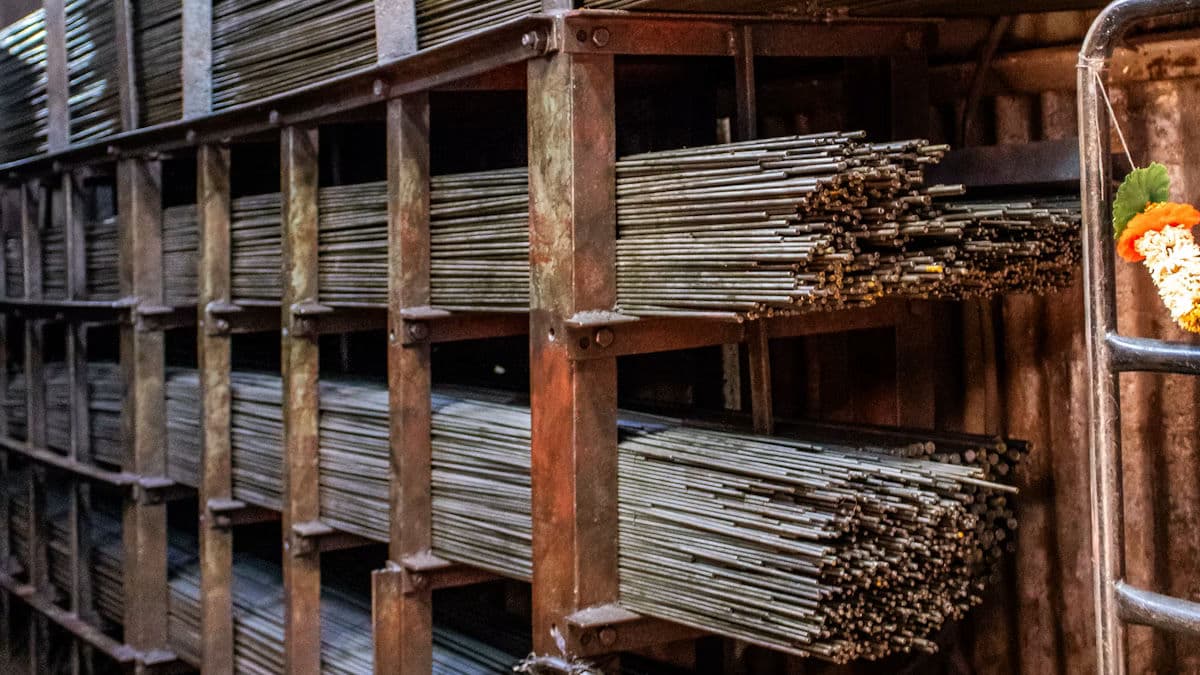
A coil arrives on a Monday. Single master heat cert, 22,000 pounds of 304 stainless, chemistry and mechanical properties confirmed, specification met. Without a dedicated MTC management system, metal service centers typically handle this the same way: the cert goes somewhere (email, shared drive, maybe the receiving desk) while the coil moves to the slitter.
By Friday you have slit that coil into eight strips. Those strips get blanked into three different sizes across two production runs. Over the next three weeks, four customers receive shipments. Each gets a packing slip.
How many of those customers receive documentation that actually traces back to the original mill cert? In most metal service centers, the honest answer is: the first one, if they asked. After that, it depends on whether someone remembered to make a copy, whether the blank tags still show the coil number, and whether the person who handled receiving that Monday is still at their desk when the fourth customer calls asking for their cert package.
This is not a documentation problem. It is a material identity problem. And it gets worse every time material goes through a process operation.
Quick Answer
Metal service centers need an MTC management system because slitting, blanking, and cut-to-length operations sever the link between inventory and the original mill cert, a link that manual filing systems cannot reliably maintain through every processing step. A dedicated system propagates the parent cert to every child item created from a heat, so traceability survives slitting, CoC generation is automated, and multi-warehouse pulls trace back to one cert.
What Processing Does to Cert Traceability
Processing operations break cert traceability because every slitting, blanking, or cut-to-length run creates new inventory items from a single certified parent heat, and most filing systems have no mechanism to propagate the parent cert to the children.
The mill cert covers the parent material: the coil, the plate, the bar. Every property on that cert (tensile strength, yield, elongation, chemistry) applies to the heat as received. When you slit, blank, cut to length, or level that material, you are not changing its properties. But you are creating new inventory items that your system treats as separate from the original.
Slitting a coil into eight strips creates eight line items in your warehouse management system. Each strip gets a tag. If your system is well-configured and someone is diligent, that tag includes the original coil number. In practice, tags get replaced, updated, or lost through handling. By the third picking cycle, the link between a strip and its parent coil exists only in the institutional memory of whoever received it.
Cut-to-length and blanking compound the problem further. A strip produces 40 blanks. Those 40 blanks may ship across six different orders over two months. Each order needs a cert package. The cert package needs to reference the original heat. The heat information needs to survive from the coil receipt through slitting through blanking through picking through shipping, across however many weeks and however many hands that material passes through.
Manual systems cannot maintain that chain reliably. People are careful when material is fresh. When material has been sitting in bay 7 for six weeks and the person who received it has moved on, the traceability degrades. By the time a customer audit finds the gap, the material is already shipped and the cert package is whatever someone assembled from what they could find.
The Branded CoC Gap
Even when a service center can locate the original mill cert, that document is not what most customers want to receive. They want a certificate of conformance on your letterhead, referencing your sales order, your part numbers, your shipped quantities, and signed by your quality manager.
The mill cert proves the heat met specification. Your CoC confirms that the specific material you shipped came from that heat and met the applicable requirements. These are different documents serving different functions. Sophisticated buyers, especially in automotive, aerospace, and defense supply chains, require both.
Generating a CoC manually takes time. Someone opens a Word template. They copy chemistry and mechanical property values from the mill cert by hand. They fill in the customer name, the order number, the shipped quantities, the applicable specification. They check the values for transcription errors. They get a signature. The document goes into the shipment package or goes out by email.
At a service center running 50 orders per day, that process consumes 8 to 12 hours of labor daily. That is one to one and a half full-time employees doing nothing but cert paperwork. The work produces no value beyond what the mill cert already established. It just reformats and repackages information that already exists. And because the values are transcribed by hand, there is a non-zero rate of transcription error that creates a new quality risk on top of the administrative cost.
Ready to automate your certificate workflow?
Try TestCert freeMulti-Warehouse Cert Linkage
Service centers with multiple locations face a traceability problem that scales with their footprint. Material from the same heat may be stored across two or three warehouses, having arrived in separate coils or plates from the same mill order. When a customer orders a quantity that requires pulling from multiple locations, the cert package needs to cover material from all of them, from a single set of heat certifications.
The operational scenario looks like this: a customer orders 300 pieces of a specific grade and size. Warehouse A has 180 pieces. Warehouse B has 140 pieces. You pull 180 from A and 120 from B. The material traces to the same heat. The cert is the same document. But the picking records, the shipping records, and the cert package need to reconcile pulls from two locations into a single shipment with coherent documentation.
Without a system, this is a manual exercise. Someone at the home location calls or emails warehouse B to confirm the heat number on the inventory. They locate the cert. They assemble the package. If the B location stock was received at a different time under a different receiving record, finding the cert connection may require digging through records that were not organized with multi-location traceability in mind.
For service centers operating at scale, this happens dozens of times per week. Every time it requires manual intervention, it consumes time and introduces the possibility of error. Every time a cert package goes out with an incorrect quantity or a mismatched heat reference, it creates a discrepancy that the customer may or may not catch, and that an auditor definitely will.
What a System Changes
An MTC management system changes the fundamental unit of cert organization. Instead of filing certs by receiving document or by purchase order, the system indexes everything by heat number at the moment of receipt. Every subsequent operation (slitting, blanking, cut-to-length, picking, shipping) maintains its link to the originating heat record.
When a coil is slit into eight strips, each strip inherits the parent coil's heat assignment in the system. The strips do not lose their identity through the slitter. When those strips are blanked, the blanks carry the same heat reference. When a customer order pulls 40 blanks from inventory, the system knows which heat those blanks came from without anyone needing to trace tags or check receiving records.
Certificate of conformance generation becomes an automated output rather than a manual task. The system knows the heat, it knows the chemistry and mechanical properties from the stored mill cert, it knows the customer, the order number, the shipped quantities, and the applicable specification. The CoC generates from that data, on your letterhead, with your branding, signed by the right authority, in the time it takes to approve and print. Transcription errors disappear because the values are pulled from a database, not copied from a PDF by hand.
Multi-warehouse cert linkage becomes a query rather than a phone call. When a shipment pulls from two locations, the system identifies the heat records covering both pulls and assembles the cert package automatically. The quality manager sees one coherent document package for one shipment, regardless of how many warehouses contributed to it.
For service centers with customers who require digital cert delivery before the truck leaves, increasingly common in automotive and aerospace supply chains, that delivery becomes possible without a last-minute scramble. The cert package is assembled when the shipment is confirmed, not when the driver is waiting at the dock.
The Traceability Standard Is Rising
Customer quality expectations for metal service centers are not static. Automotive OEMs tightening IATF 16949 compliance requirements are pushing those requirements down the supply chain. Aerospace primes under AS9100 surveillance are reviewing supplier quality systems more frequently. Defense contractors subject to DFARS material traceability requirements are auditing distributors and service centers with more scrutiny than they applied five years ago.
The common thread across all of these requirements is that material identity must be maintained from mill cert to end use, through every processing step, every warehouse move, every partial shipment. Documentation that was acceptable under less rigorous standards is now generating findings. Those findings trigger corrective action plans. Repeated findings lead to supplier qualification reviews.
Service centers that built their cert management on shared drives, email folders, and hand-typed CoC templates built those systems when the requirements were less demanding. The systems worked well enough at the time. They are not equipped for the traceability standard that industrial customers are now applying.
The investment in a structured MTC management system is not primarily about reducing paperwork, though that benefit is real and measurable. It is about building the operational infrastructure to maintain material traceability through a level of processing complexity that manual systems cannot handle reliably. When a customer audit asks to trace a shipment from four months ago back to its original mill cert, through two process operations and a warehouse transfer, the answer should take thirty seconds, not a morning.
Service centers that can answer that question quickly keep their customers. Service centers that cannot are explaining themselves to quality auditors, and eventually to procurement teams deciding who stays on the approved vendor list.
Frequently Asked Questions
What happens to mill cert traceability when a coil is slit?
When a coil is slit into strips, the original mill cert covers the parent coil, not the individual strips. Without a system that propagates the parent cert to each child item, traceability breaks at the slitter. In practice this means customers receiving slit strip may get a forwarded mill PDF that doesn't clearly identify their specific material, or no cert at all. A proper MTC system creates child records for each slit item inheriting the parent heat cert, so every strip is individually traceable.
How do service centers generate branded certificates of conformance?
A branded Certificate of Conformance (CoC) is generated on the service center's letterhead and certifies that the material supplied meets the applicable standard. It is not the original mill cert forwarded from the producer. Generating it manually requires pulling the mill cert values, transferring them to a CoC template, and reviewing for accuracy, typically 10–15 minutes per shipment. An MTC management system generates the CoC automatically from the linked heat cert data, with the service center's branding, in seconds.
How do service centers manage mill cert traceability across multiple warehouses?
Multi-warehouse cert traceability requires that when an order is fulfilled from two or more locations, the cert package accounts for all pulls and traces each back to its source heat cert. In a manual system, this requires coordinating between warehouse teams and manually assembling the combined cert package, a process prone to omission. A digital MTC system links inventory records across locations to a shared heat cert library, so a multi-site order produces a single traceable cert package automatically.
Ready to automate your certificate workflow?
Try TestCert free